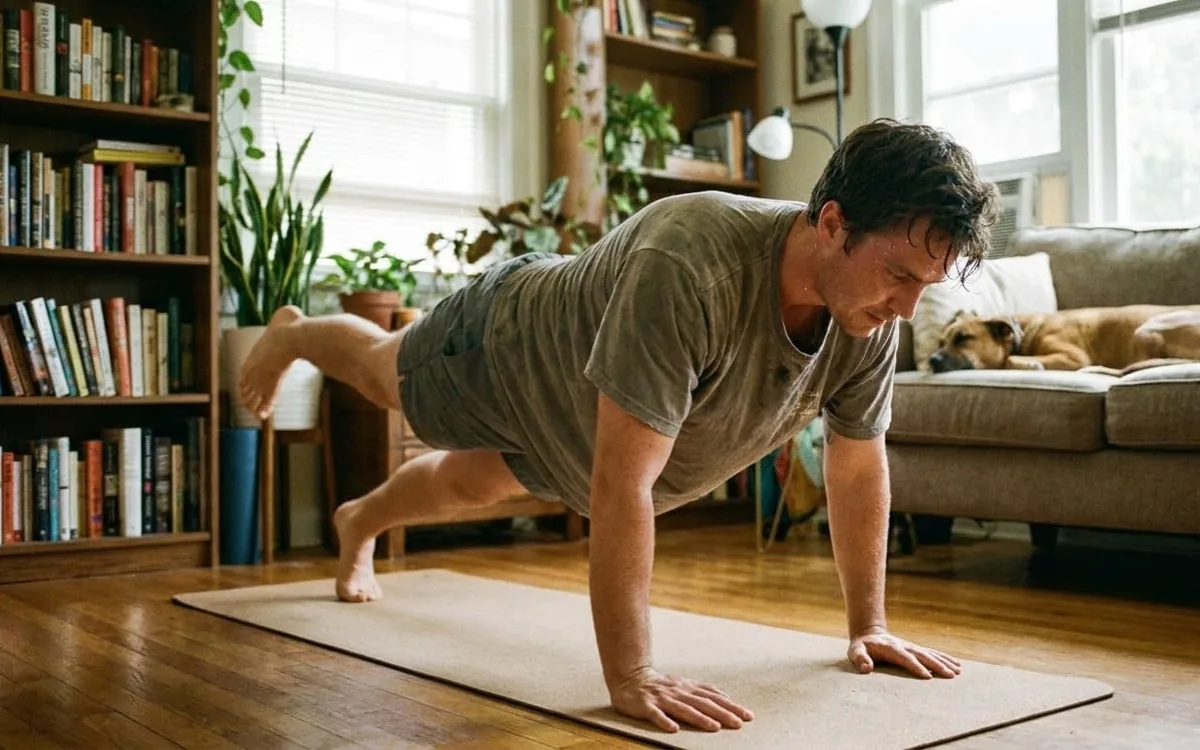
Key takeaways
- Short workouts can be useful when they help you stay active and consistent.
- The routine covers a squat, push, hinge, core and simple conditioning movement.
- Scale the exercises before increasing speed.
- On very low-energy days, doing a shorter version is still a reasonable option.
A 20-minute bodyweight workout can provide useful activity when time is limited. Use a few major movement patterns, keep technique controlled and repeat the session consistently.
Twenty minutes is long enough to move your whole body and short enough to fit between real-life responsibilities. The goal of this session is not to create maximum exhaustion. It is to give you a repeatable workout that feels worthwhile on days when time is limited.
The 20-minute structure
| Part | Time | What to do |
|---|---|---|
| Warm-up | 3 minutes | March, arm circles, easy squats and hip hinges |
| Circuit | 12 minutes | 40 seconds work, 20 seconds transition |
| Finisher | 3 minutes | Brisk march, step-ups or easy shadow boxing |
| Cool-down | 2 minutes | Easy walking and relaxed breathing |
The six-move circuit
- Bodyweight squat.
- Incline or floor push-up.
- Glute bridge.
- Alternating reverse lunge or supported split squat.
- Bird dog.
- March in place or low-impact mountain climber.
How to scale it
Use a chair or wall for support on squats and split squats. Raise your hands onto a sturdy surface for incline push-ups. Reduce the work interval to 25–30 seconds when the full forty feels too demanding. The aim is controlled movement, not survival.
How to progress
When the routine becomes comfortable, add a third circuit movement, increase the work interval slightly or choose a harder exercise variation. You can also slow the lowering phase of squats and push-ups to make them more demanding without increasing speed.
What not to do
- Do not rush through repetitions to make the workout feel harder.
- Do not hold your breath through every rep.
- Do not turn every short workout into a maximal conditioning test.
- Do not ignore sharp pain because the workout is short.
When this workout is most useful
Use it on busy weekdays, travel days, or anytime you want to keep the habit alive. It can also be an entry point for beginners who feel overwhelmed by longer gym sessions.
Pair it with walking
On days without strength training, a brisk walk can add more low-complexity activity without making recovery difficult for most people. General activity guidance emphasizes that any movement is better than none and that activity can be spread through the week.
If you have an injury, significant joint pain, a chronic medical condition or another reason to need individualized exercise advice, modify the routine with appropriate professional guidance.
Frequently asked questions
Can 20 minutes really be enough?
A 20-minute workout is not the same as a full training session every time, but it can still provide meaningful activity and help you stay consistent.
How often can I do this workout?
Two or three times a week is a practical starting point, especially if you also do other activity.
Should I do this before or after cardio?
Either can work. Choose an order that keeps the quality of the movements high and does not make the strength portion unnecessarily difficult.
Who this is for
Generally healthy adults looking for practical, evidence-informed guidance on this topic.
Who should be cautious
Anyone with a relevant injury, chronic condition, or who is pregnant should check with a qualified healthcare provider before applying this guidance.