Key takeaways
- Mobility is about how you can actively move through a range, not just how far you can stretch passively.
- Gentle movement is often more useful than forcing a deep stretch when you feel stiff.
- A short routine can be repeated regularly instead of saved for one long stretching session.
- Pain and stiffness are not the same thing; persistent or worsening pain deserves assessment.
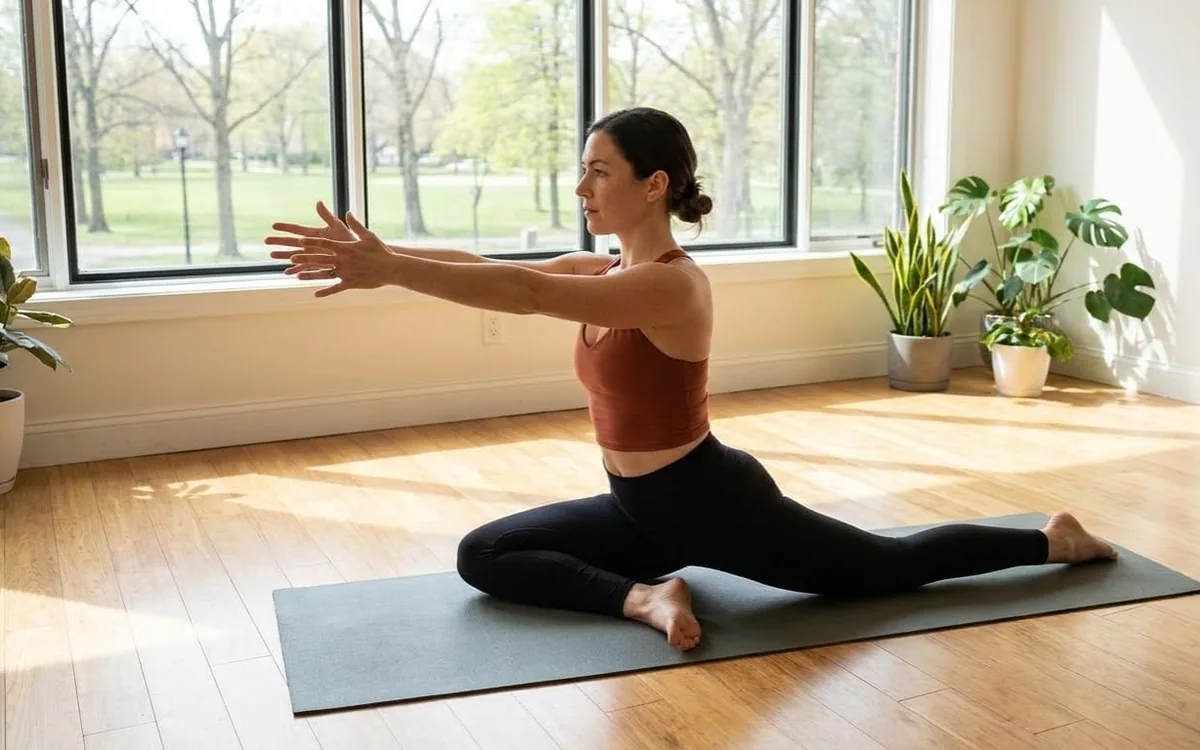
A short mobility routine can help you explore comfortable movement around the hips. Use controlled ranges, avoid forcing painful positions and repeat the work regularly rather than relying on occasional long sessions.
Hips can feel stiff after long periods of sitting, after a demanding leg workout or simply because you have not moved much that day. A mobility routine is not supposed to force your body into extreme positions. It should give you a few controlled opportunities to move through comfortable ranges and notice where you feel restricted.
The five-move routine
| Movement | Time or reps | Focus |
|---|---|---|
| 90/90 switches | 6–8 per side | Rotate slowly and stay tall |
| Half-kneeling hip shift | 6 per side | Move gently through the front of the hip |
| Adductor rock-back | 8 per side | Keep the extended leg relaxed |
| Glute bridge | 10–12 reps | Move from the hips, not the lower back |
| Supported deep squat hold | 20–30 sec | Use support and stay in a comfortable range |
Move slowly enough to learn the position
The goal is control. If you bounce or force the end range, it becomes harder to tell whether the limitation is simply stiffness or something that should not be pushed.
Before a workout vs. after a workout
Before training, active movement and lighter repetitions are a practical way to prepare for the specific movements you are about to do. After training or on a recovery day, longer comfortable static positions may be useful when flexibility is one of your goals.
Use support without feeling guilty
Holding a wall, chair or sturdy surface can make a position more controlled. Support is especially useful in deep squat variations, balance drills and positions where you are trying to explore range rather than prove how flexible you are.
How often to practice
Five to ten minutes several times a week is easier to maintain than one giant mobility session. You can do this routine before a lower-body workout, after a long workday or on a light recovery day.
What improvement should feel like
You may notice that the movement feels smoother, the range becomes easier to access or you no longer need as much warm-up time to feel comfortable. Mobility gains are often subtle and gradual rather than dramatic from one session to the next.
A mobility routine should feel like controlled exploration, not a contest. Stop or change the movement when you feel sharp pain, numbness or symptoms that do not feel like ordinary stretching or muscular effort.
Frequently asked questions
Do I need to stretch every day?
No. Frequency depends on your goals and how you respond. Short, regular practice is often easier to maintain than forcing daily sessions.
Can mobility work fix all tightness?
No. Stiffness has many possible causes, and a mobility drill is not a universal treatment for pain or joint problems.
Should mobility work hurt?
It should not require sharp or worsening pain. Stay within a controlled, tolerable range.
Who this is for
Generally healthy adults looking for practical, evidence-informed guidance on this topic.
Who should be cautious
Anyone with a relevant injury, chronic condition, or who is pregnant should check with a qualified healthcare provider before applying this guidance.